Bread motif
A Gentleman in MoscowBread motif binds the novel’s material hardships to its most intimate acts of fellowship and remembrance. It appears first as food made precious by scarcity, then as warmth and sustenance in a moment of escape, and finally as the subject of Mishka’s book, through which bread gathers religious, literary, and personal meanings. Its transformations make an ordinary loaf register both the conditions imposed on a people and the attachments that survive them.
Scarcity and Ingenuity
When Emile Zhukovsky arrived at the Metropol as chef de cuisine in 1912, his command of a seasoned staff, a substantial kitchen, and an abundant larder offered little test of his skill. The novel instead measures his talent against want. After the Revolution, economic decline, failed crops, and halted trade emptied the hotel’s stores. Fine ingredients disappeared, leaving Emile to cook with cornmeal, cauliflower, cabbage, and whatever else he could obtain. Bread belongs to this world of constrained choices: food is no longer an effortless sign of plenty but a basic necessity whose availability reflects larger political and economic conditions.
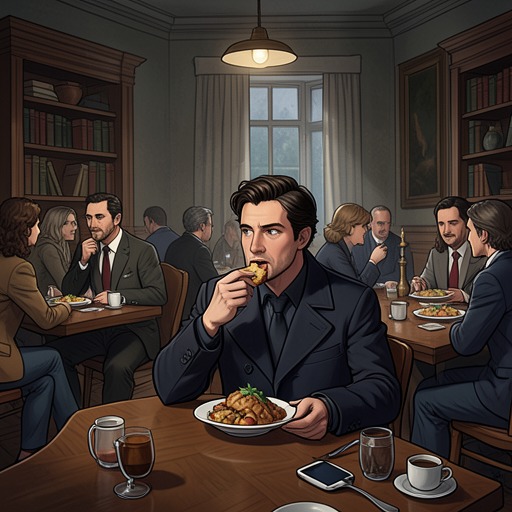
Emile’s response to scarcity is not resignation but substitution. The saltimbocca Count Alexander Ilyich Rostov is eating has no veal cutlet, Parma prosciutto, or sage. Emile has pounded chicken breast flat, replaced the prosciutto with Ukrainian ham, and chosen a more bitter aromatic herb in place of sage. The dish demonstrates a broader logic that the bread motif later makes explicit: familiar forms of nourishment and pleasure must be remade from what remains. The achievement is not that deprivation has vanished, but that skill can preserve some measure of abundance and hospitality within it.
Bread as Food and Fellowship
The novel also places bread in scenes of shared eating. At one in the morning, three conspirators sit down before a single candle, a loaf of bread, a bottle of rosé, and three bowls of bouillabaisse. The modest loaf is part of a deliberately spare meal, not an incidental detail in an abundant spread. The men dip their spoons into the stew together, while Emile watches the others’ faces before tasting his own portion. Bread sits within this small ceremony of trust and anticipation, where eating together makes companionship tangible.
A much larger image of bread appears when Count Alexander Ilyich Rostov reaches an alley near dawn and encounters a van marked Red Star Baking Collective. The young man at the passenger door asks no questions; he opens the back, and the Count climbs in. Only after the door closes does the Count recognize the smell of fresh bread. Along one side of the van, more than two hundred loaves sit in orderly rows. He touches one and finds it soft and warm, less than an hour from the oven. The van carries him onto the open road, but its cargo gives the passage its startling physical immediacy: after confinement and danger, the Count is surrounded by freshly made food. Bread is at once practical cargo and a sensory sign of life continuing beyond the walls he has left.
Mishka’s Book
Bread becomes an archive when Katerina Litvinova visits the Count at Mishka’s request, carrying a rectangular parcel wrapped in brown paper and tied with twine. Inside is a small leather-bound volume titled Bread and Salt. Its roughly cut pages and loose threads reveal a dedicated amateur’s handiwork. Tucked into the title-page seam is a photograph taken in 1912 at the Count’s insistence: the young Count stands in a top hat, while Mishka appears ready to sprint out of the frame. Mishka had kept the photograph. The book therefore arrives not simply as a text but as a material inheritance, joining an old image of friendship to the work Mishka left behind.
The volume collects passages from seminal texts in chronological order, altering each by capitalizing and bolding the word bread. It begins with biblical references: bread appears in the account of Adam’s labor and mortality, in the temptation to turn stones into loaves, and in the breaking of bread at the Last Supper. The word is thereby connected to work, survival, spiritual sustenance, and remembrance. The book then moves through Greek and Roman writing, Shakespeare, Milton, and Goethe, with particular attention to the golden age of Russian literature. In a passage from Gogol’s The Nose, the act of cutting bread leads to the discovery of a nose inside the loaf. The recurring word does not hold one fixed meaning; the project’s playfulness lets it travel across sharply different literary worlds.
Grief, Memory, and Censorship
The book’s emotional force comes into focus in its citation from Dostoevsky’s The Brothers Karamazov. A dying boy asks his father to crumble a crust on his grave so that sparrows will come and he can hear them, glad not to lie alone. Reading this passage, Count Alexander Ilyich Rostov breaks down and weeps for Mishka, whose generous, temperamental nature had found its moment only briefly. He also weeps for himself: although he has friends and loved ones, Mishka’s death means that the last person who knew him as a younger man is gone. Katerina’s reminder that he can still remember does not undo the loss; it gives remembrance a task.
The sequence of citations ends in June 1904 with sentences from Chekhov’s letter about enjoying the food in Berlin and the quality of its bread. Mishka had cut the sentences from the letter many years earlier. The Count can understand why censorship during the hardships of the 1930s might have treated praise of foreign bread as a source of discontent. Yet the omission has become ironic: by then, the Russian people know from deprivation how good bread can be. The book’s final historical note thus joins censorship to hunger, showing how a politically sensitive comparison can change meaning as circumstances change.
The Motif’s Last Turn
Bread links bodily need to the work of memory without making either meaning abstract. It is an ingredient that Emile must work around, a loaf set out among friends, warm cargo in a van, and the subject that gives Mishka’s literary compilation its structure. In the Dostoevsky passage, a crust is also an imagined gift to the dead, meant to draw sparrows to a grave and keep a child from feeling alone. Across these appearances, bread marks the distance between abundance and want, but also the small gestures through which people answer want and loss.
After closing Mishka’s book, the Count remains in his study rather than going downstairs. He initially seems absorbed in memories of his friend, but his thoughts turn instead to Katerina and to the unsettling change in a woman he remembers as a firefly, a pinwheel, and a wonder of the world. The ending returns the reader from the book’s long survey of bread to a living relationship whose future the Count cannot settle. The volume preserves what Mishka made and what he remembered; the Count’s response shows that remembrance also presses forward, toward those who remain.